 CodexWork
Three Riverbend branch directors have eight minutes to decide whether to extend Saturday opening, continue a limited pilot or stop. Four fictional files became an editable presentation. A later cost update changed the numbers, but not the recommendation: continue only a bounded pilot, with resources approved and comparable measurement arranged.
Open the finished presentation
Reviewed six-slide PowerPoint · Reviewed Word outline, speaker notes and source map
The deck was made in an actual GPT-6 Pro chat. The final Word companion was then editorially corrected to attribute the new cost to the later update and make the combined-cost derivation explicit. That distinction matters: the chat produced editable files and a meaningful revision, but it did not finish a clean source map on its own. The review record identifies exactly what changed.
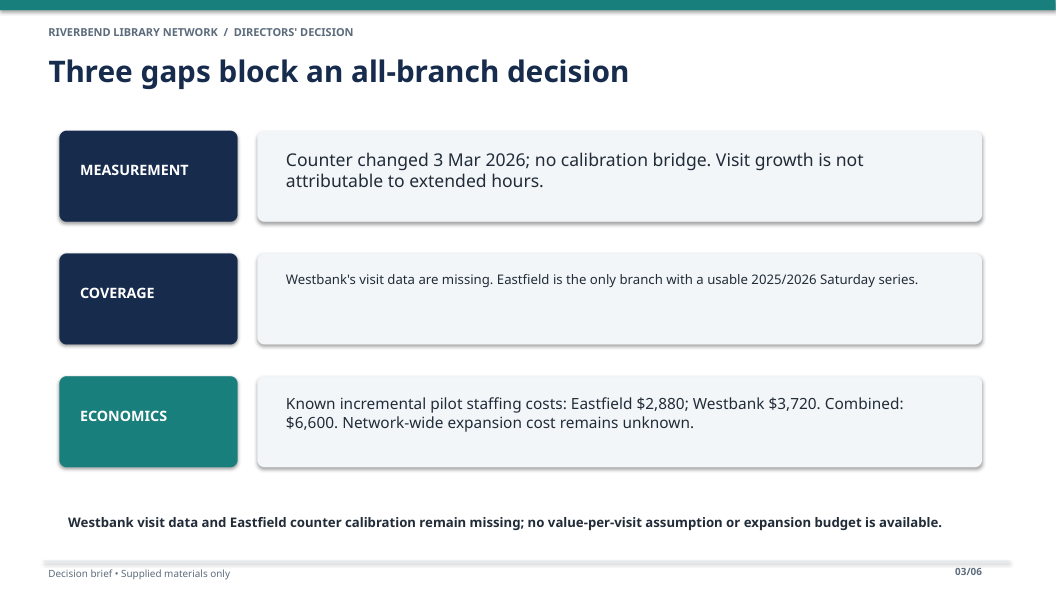
The final figures are Eastfield USD 2,880, Westbank USD 3,720 and a known two-branch total of USD 6,600. That is not an all-branch expansion budget. Missing Westbank visits, the changed Eastfield counter and absent expansion approval still limit the decision. Speaker notes are in Word, not PowerPoint’s Notes pane.
See the initial decision unfold
This complete web illustration uses the initial four files, before Westbank’s cost arrived. It was authored for this page and is separate from the chat-made deck above.
Continue a bounded pilot before expanding
Notes and sources
This is a recommendation, not an approved decision. The source provides no all-branch budget.
The evidence covers one branch’s visits
Notes and sources
The denominator is 12 Saturdays per year at Eastfield, not all network visitors or every pilot branch.
Visits rose 15.2%; the counter change limits confidence
Notes and sources
2025 sum 3,312 / 12 = 276. 2026 sum 3,816 / 12 = 318. Do not infer that hours caused this change.
Staffing cost is known for only one pilot branch
Notes and sources
Costs are USD for Apr–Jun 2026 at Eastfield. Do not extrapolate an expansion budget or ROI from this one branch.
Three unknowns block an expansion decision
Notes and sources
These are decision-changing omissions, not evidence that the pilot failed. Owners and deadlines were not supplied.
Expand only after measurement and cost gaps close
Notes and sources
No new period, owner or budget is committed by this deck. Ask directors to choose the next measurement plan rather than approve unsupported expansion.
Fictional example · Authored illustration Editable PowerPoint ↓
Eastfield’s recorded Saturday average rises from 276 in 2025 to 318 in 2026 across 12 Saturdays in each year: a descriptive difference of 15.2%. But its counter changed on 3 March 2026 without a calibration bridge. The difference cannot be credited to the extra hours.
Westbank’s visits and staffing cost are missing from those initial inputs. There is no network-wide budget or expansion approval. The source gaps belong beside the claims they affect, not in a disclaimer on the last slide.
Authored initial PowerPoint · Initial outline · Initial speaker notes · Initial source map
Optional / the fictional example
Try this example with your own AI
Use an assistant that can read attachments and create downloadable files. To recreate Riverbend, attach these four fictional starter files, give it the task below, then open the saved result. For your own task, start with your own materials instead.
Copying the task does not start an Agent. Use only materials you are allowed to share with your chosen service.
Change a fact, then follow it through the files
After saving the first output, the recorded run supplied this update:
Westbank ran 12 pilot Saturdays in Apr–Jun 2026, at an incremental staffing cost of USD 310 per Saturday. No new visit data, counter calibration or expansion approval is available.
Ask your Agent to revise the presentation and companions, preserve the first version and explain what changed. Westbank’s added cost is USD 3,720; the two-branch total is USD 6,600. More complete cost information is not evidence of benefit or approval to expand. The later update is a separate source, not something the initial staffing table already said.
In the actual run, the first revision got the new totals right but left “Westbank costs unavailable” in the Word source map. One targeted corrective follow-up removed that wording, yet retained a citation to the old files. It also lost the explicit combined-cost source-map entry. Local editorial review repaired those remaining references in the finished companion above; no further model call was made.
A useful revision request is:
Replace superseded claims throughout the deck, outline, speaker notes and source map. Cite the source that actually supplies each new fact, and show the derivation of changed totals. Compare the revised files for conflicts. Preserve the first version separately.
The recorded failures are why source review matters here. This wording is guidance, not a guarantee that a future chat will complete the review correctly.
Inspect the unchanged chat outputs
- First turn: PowerPoint and Word companion.
- Cost revision: PowerPoint and Word companion.
- Single corrective follow-up: PowerPoint and Word companion.
The original two-turn record and corrective follow-up record preserve their distinct outcomes. The files opened, rendered and survived representative edit/save/reopen checks. The original trial was mixed; the corrective follow-up was a partial repair. Neither becomes an autonomous success because the later editorial reference is usable.
Bring a different decision
Tell your Agent who needs to decide, the choice they face and how much time they have. Supply the relevant notes and data, including known gaps or conflicts. You do not need a library scenario or exactly two tables, and Riverbend’s conclusion should not become your default answer.
A useful first request is:
Help [audience] decide [the actual choice] in [the time available]. Use my attached notes and current data. Make the shortest useful recommendation and suggest the right format; do not assume I need six slides. If a fact or decision is missing, ask me or show the gap.
One lesson from the finished deck transfers directly: a new fact can reach the main document while an old statement survives elsewhere. Compare your current task table with earlier notes. Which statuses, owners or dates conflict? Which are proposals, and which were actually confirmed? Carry any resolved change through the summary and its supporting material, without turning an unresolved conflict into certainty.
If your job is to get a manager up to date rather than ask for a decision, use the weekly-update brief. It works from your own notes and task list; a presentation is not required.
Open the actual output. Can you edit it? Can you follow an important number to its source? Do changed claims agree across the slides and companion files? If the assistant gives advice about making a presentation instead of a file, ask for the file explicitly. File creation depends on your interface and account.
Sources
The audience brief sets the decision and eight-minute limit. Research notes explain the pilot, counter change and initial gaps. Saturday visits contains Eastfield’s figures. Staffing costs contains its initial cost information. The later supplied update adds Westbank’s cost without adding visits or approval.
Riverbend is fictional. This is a reviewed, agent-assisted worked result, not a customer engagement, ordinary-user adoption study or promise of unattended correctness. Reading the work is a complete use of the page; trying the materials with your own Agent is optional.